
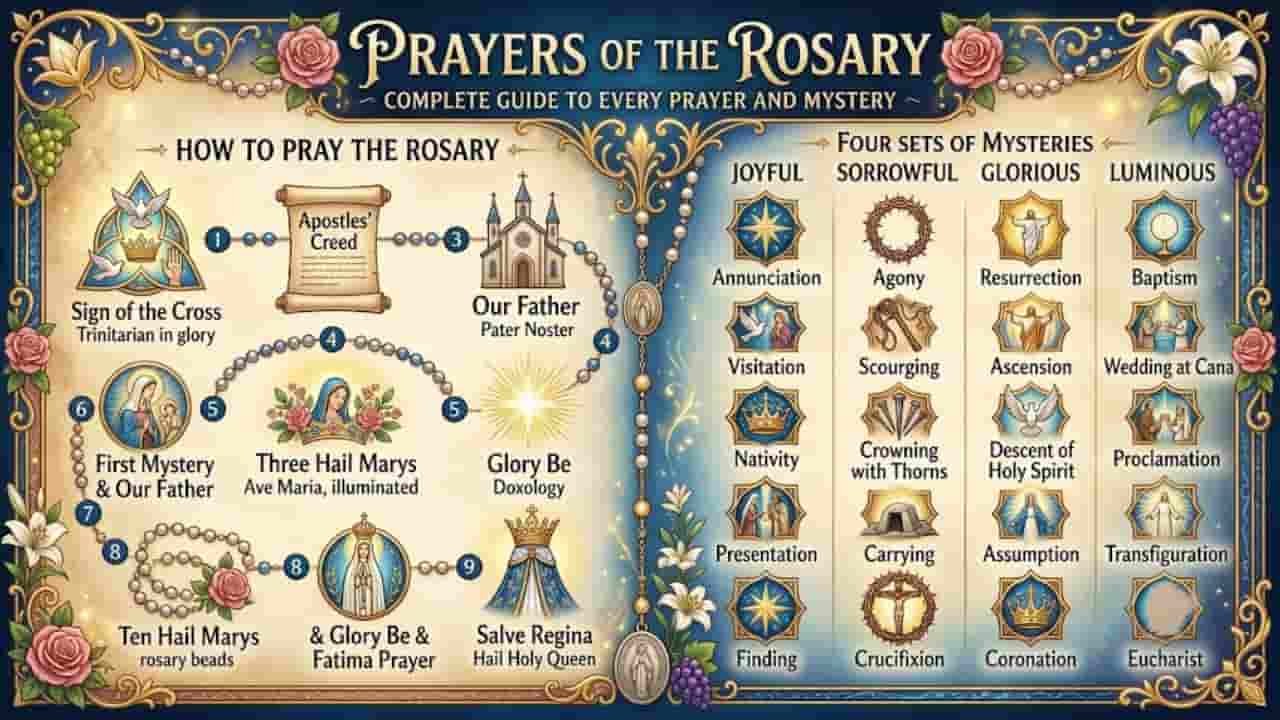
Have you ever wanted to pray the Rosary but felt unsure about the order or which prayers to say? Learning the Prayers of the Rosary can feel confusing at first, especially if you are new to this meaningful Catholic devotion or returning to it after some time.
In this guide, you’ll find the Prayers of the Rosary explained in a simple, easy-to-follow way. We’ll walk through the main prayers and their order so you can pray with greater confidence, peace, and devotion.
What Are the Prayers of the Rosary?
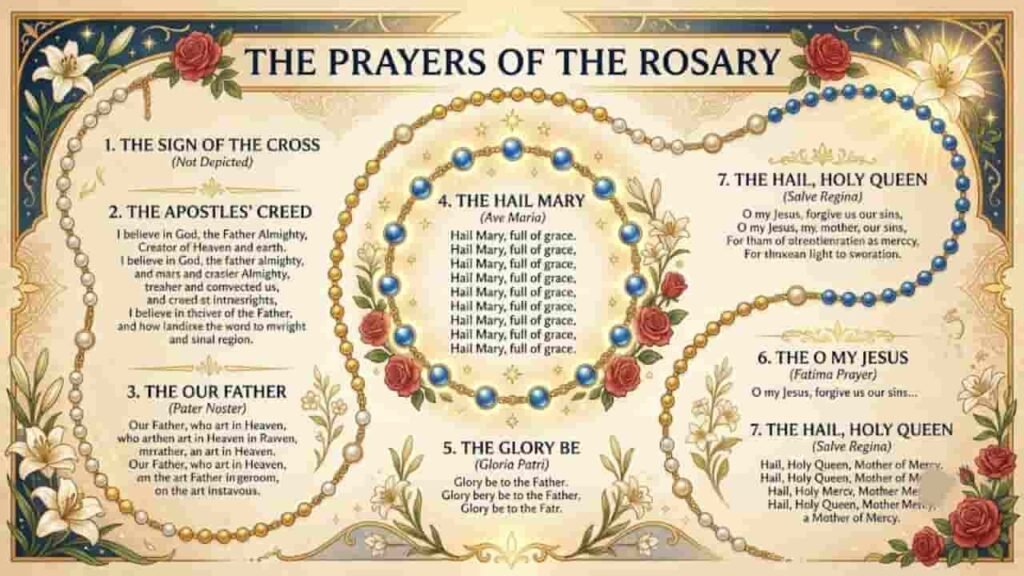
The Rosary is a traditional Catholic devotion that combines spoken prayer with meditation on important events from the life of The Savior and the Blessed Virgin Mary. It uses a series of familiar prayers, including the Apostles’ Creed, Our God, Glory Be, and other traditional Catholic prayers. Rather than simply repeating words, Catholics traditionally use the prayers to reflect on the Gospel and the mysteries.
The Rosary is organized around decades, with each decade containing one Our GOd, ten decade prayers, and one Glory Be. A devotional prayer is also commonly included after the Glory Be. As you move through the decades, you meditate on one of the four groups of Mysteries: Joyful, Sorrowful, Glorious, or Luminous. This combination of prayer and meditation makes the Rosary both structured and deeply personal.
How to Pray the Rosary Step by Step
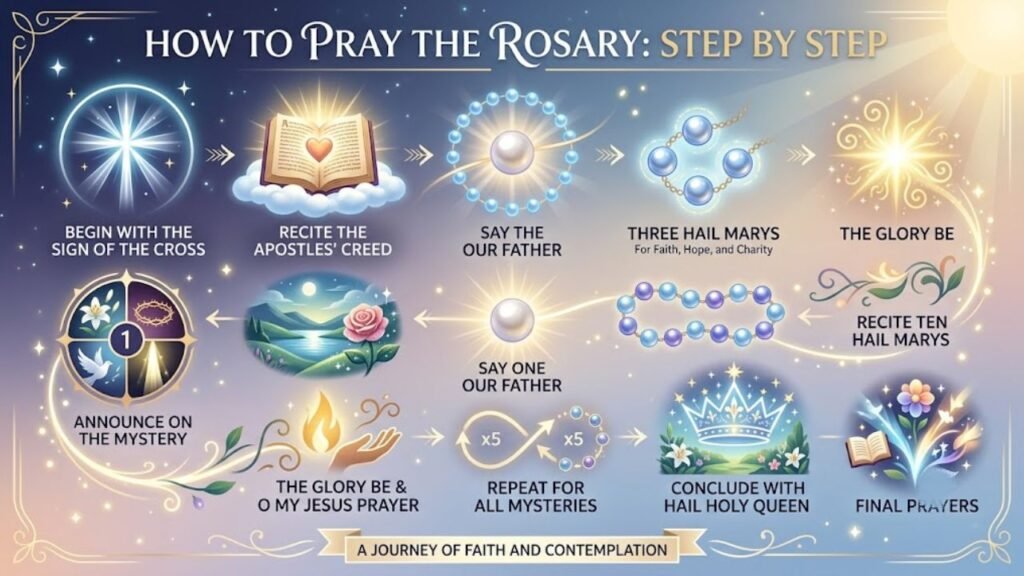
Learning how to pray the Rosary doesn’t require you to memorize everything at once. The easiest approach is to follow the Rosary beads and move through each prayer in order. With regular practice, the sequence becomes familiar and allows you to spend more attention on the mystery you are contemplating.
A traditional Rosary begins with the opening prayers, continues through five decades, and ends with closing prayers. Each decade follows the same basic pattern, which makes the Rosary easier to learn for beginners. If you lose your place, simply pause, find the correct bead, and continue without worrying about getting everything perfect.
Read More: 40+ Exam Success Wishes And Prayers
The Opening Prayers
Begin by making the Sign of the Cross while holding the crucifix. Then pray the Apostles’ Creed. On the first large bead, pray to Our God, followed by three decade prayers on the next three beads. These three decade prayers are traditionally offered for an increase in faith, hope, and charity. Then pray the Glory Be.
After the opening prayers, announce the first Mystery and begin the first decade. The exact way people introduce a Mystery can vary slightly according to local Catholic custom, but the important part is to identify the Mystery and thoughtfully reflect on it while praying.
Praying the Five Decades
Each decade begins with an announcement of the Mystery. Pray the Our God on the large bead, followed by ten decade prayers on the smaller beads. Finish the decade with the Glory Be and, according to the common practice of many Catholics Prayer.
Repeat this pattern for all five decades. The Rosary prayer steps are intentionally repetitive because the repetition creates space for meditation rather than requiring constant attention to new words. While saying the decade prayers, reflect on the Gospel event connected with that particular Mystery.
The Closing Prayers
After completing the fifth decade, continue with the closing Marian prayer, followed by any additional prayers you usually include. Some Catholics then pray an additional concluding prayer and make the Sign of the Cross. These closing prayers bring the devotion to a peaceful end and turn attention toward Mary as a mother who points believers toward Christ.
There can be slight differences in local customs and prayer traditions. If you’re following a particular parish, prayer group, or Catholic prayer book, it’s perfectly reasonable to follow its established form. The goal isn’t to create anxiety about small differences but to pray with faith and attention.
The Complete Prayers of the Rosary
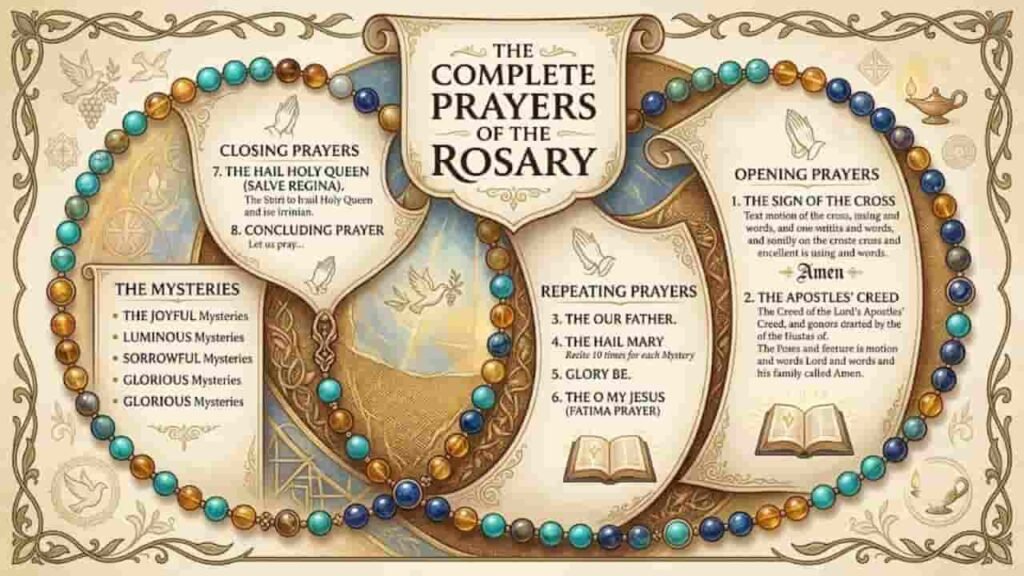
Knowing the order is helpful, but beginners often want to know the actual prayers themselves. The following complete prayers of the Rosary are arranged according to their traditional place in the devotion. You can use this section as a simple Rosary prayer guide while learning the sequence.
It can take time to become comfortable with every prayer. You don’t need to memorize everything immediately. Many people keep a Rosary prayer card, prayer book, or trusted guide nearby until the words and order become familiar.
Sign of the Cross
In the name of the God, and of the Son, and of the Holy Spirit. Amen.
The Sign of the Cross opens and closes many Catholic prayers. It expresses faith in the Holy Trinity and reminds the person praying that the Rosary is offered within the Christian faith.
Apostles’ Creed
I believe in God, the almighty Creator of heaven and earth, and in the Lord, who was conceived by the Holy Spirit, born of the Virgin Mary, suffered under Pontius Pilate, was crucified, died and was buried; he descended into hell; on the third day he rose again from the dead; he ascended into heaven, and is seated at the right hand of God the almighty; from there he will come to judge the living and the dead.
I believe in the Holy Spirit, the holy catholic Church, the communion of saints, the forgiveness of sins, the resurrection of the body, and life everlasting. Amen.
The Apostles’ Creed summarizes core Christian beliefs. Its place at the beginning helps establish the faith context for the prayers and Mysteries that follow.
Read More: Tristan Meaning in Greek | Name Origin, History & Cultural Context
Our God
Our God, who art in heaven, hallowed be thy name; thy kingdom come; thy will be done on earth as it is in heaven.
Give us this day our daily bread; and forgive us our trespasses, as we forgive those who trespass against us; and lead us not into temptation, but deliver us from evil. Amen.
The Our God, also called the God’s Prayer, is prayed at the beginning of each decade. It comes from the teaching of God and asks for God’s kingdom, daily provision, forgiveness, and protection.
Marian prayers of the Rosary
Marian prayers, full of grace, the God is with thee; blessed art thou among women, and blessed is the fruit of thy womb.
Holy Mary, Mother of God, pray for us sinners, now and at the hour of our death. Amen.
The Marian prayers is repeated ten times during each decade. Its words draw from Scripture and Catholic tradition while directing attention toward and asking Mary to pray for believers.
Glory Be
Glory be to the God, and to the Son, and to the Holy Spirit.
As it was in the beginning, is now, and ever shall be, world without end. Amen.
The Glory Be is a short prayer of praise to the Holy Trinity. In the Rosary, it normally concludes each decade after the ten Marian prayers.
Devotional Prayer
Forgive us our sins, save us from the fire of hell, lead all souls to Heaven, especially those in most need of thy mercy. Amen.
This prayer is commonly called the Devotional Prayer because of its association with the apparitions of Our Lady of Devotional. It is traditionally prayed after the Glory Be at the end of each decade, although its inclusion is a devotional practice rather than part of the earliest form of the Rosary.
Traditional Closing Prayer
The traditional closing prayer is a well-known Marian prayer that expresses trust in Mary’s care and intercession. It begins by honoring her as a mother of mercy and asking for her prayers during times of difficulty and hope.
The prayer continues by asking Mary to turn her merciful attention toward those who seek her help. It ultimately directs the heart toward God and asks for grace to live according to the promises of Christ.
This traditional closing prayer is commonly recited after the five decades of the Rosary. It brings the devotion to a peaceful conclusion while expressing confidence in Mary’s intercession and keeping God at the center of the prayer.
The Four Mysteries of the Rosary
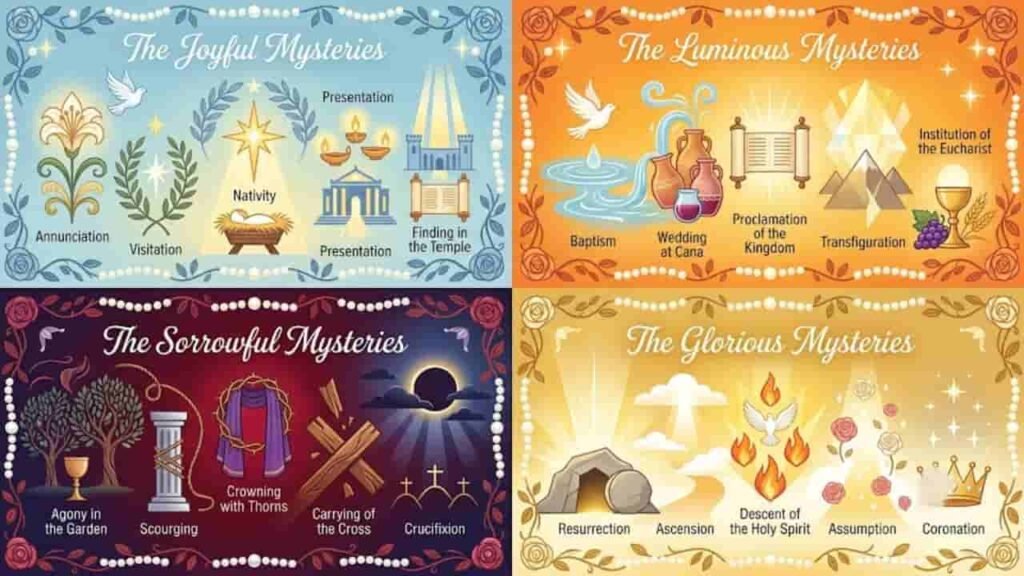
The Mysteries of the Rosary are central to the devotion because they give the prayers a subject for meditation. Instead of focusing only on the repetition of words, the person praying considers important moments connected with the life, ministry, suffering, death, and glory of God.
There are four sets of Mysteries, with five Mysteries in each set. Together, they provide twenty scenes for meditation. The Joyful, Sorrowful, Glorious, and Luminous Mysteries help guide reflection through different aspects of Christian faith.
Joyful Mysteries
The Joyful Mysteries focus on events surrounding the early life of Mary’s role in God’s plan. They invite reflection on humility, obedience, joy, family, and the coming of Christ into the world.
The five Joyful Mysteries are:
- The Annunciation — The angel Gabriel announces to Mary that she will become the mother.
- The Visitation — Mary visits Elizabeth, who recognizes the blessing of the child Mary carries.
- The Nativity — The Savior is born in Bethlehem.
- The Presentation in the Temple — Mary and Joseph present the child in the Temple.
- The Finding in the Temple — Mary and Joseph find the child among the teachers after searching for Him.
These Mysteries can encourage you to reflect on trusting God even when His plan is not fully understood.
Sorrowful Mysteries
The Sorrowful Mysteries turn the heart toward the suffering and death of Savior. They invite deep reflection on sacrifice, forgiveness, suffering, compassion, and the love shown through Passion.
The five Sorrowful Mysteries are:
- The Agony in the Garden — The Savior prays in the Garden of Gethsemane before His arrest.
- The Scourging at the Pillar — The Savior is scourged before the crucifixion.
- The Crowning with Thorns — Soldiers mock the Savior and place a crown of thorns on Him.
- The Carrying of the Cross — The Savior carries the cross toward Calvary.
- The Crucifixion — The Savior is crucified and gives His life.
While praying these Mysteries, many Catholics reflect on suffering and the meaning of sacrificial love.
Glorious Mysteries
The Glorious Mysteries focus on the Resurrection and other events associated with glory and the life of the early Church. They move the meditation from suffering toward hope, victory, and eternal life.
The five Glorious Mysteries are:
- The Resurrection — The Savior rises from the dead.
- The Ascension — The Savior ascends into heaven.
- The Descent of the Holy Spirit — The Holy Spirit comes upon the Apostles.
- The Assumption of Mary — Mary is taken into heavenly glory.
- The Coronation of Mary — Mary is honored as Queen of Heaven.
These Mysteries can be especially meaningful when you need encouragement during difficult circumstances. They remind you that Christian hope ultimately points beyond suffering toward God’s promises.
Luminous Mysteries
The Luminous Mysteries focus on important moments in the public ministry of The Savior. Saint John Paul II introduced this set of five Mysteries in 2002, expanding the traditional three sets of Mysteries.
The five Luminous Mysteries are:
- The Baptism of the Lord in the Jordan — The Savior is revealed at the beginning of His public ministry.
- The Wedding at Cana — The Savior performs His first recorded sign by changing water into wine.
- The Proclamation of the Kingdom of God — The Savior calls people to conversion and faith.
- The Transfiguration — The Savior is revealed in glory before Peter, James, and John.
- The Institution of the Eucharist — The Savior gives the Eucharist to His disciples at the Last Supper.
These Mysteries help you meditate on the public ministry of The Savior and His revelation of God’s kingdom.
Which Mysteries of the Rosary Are Prayed Each Day?
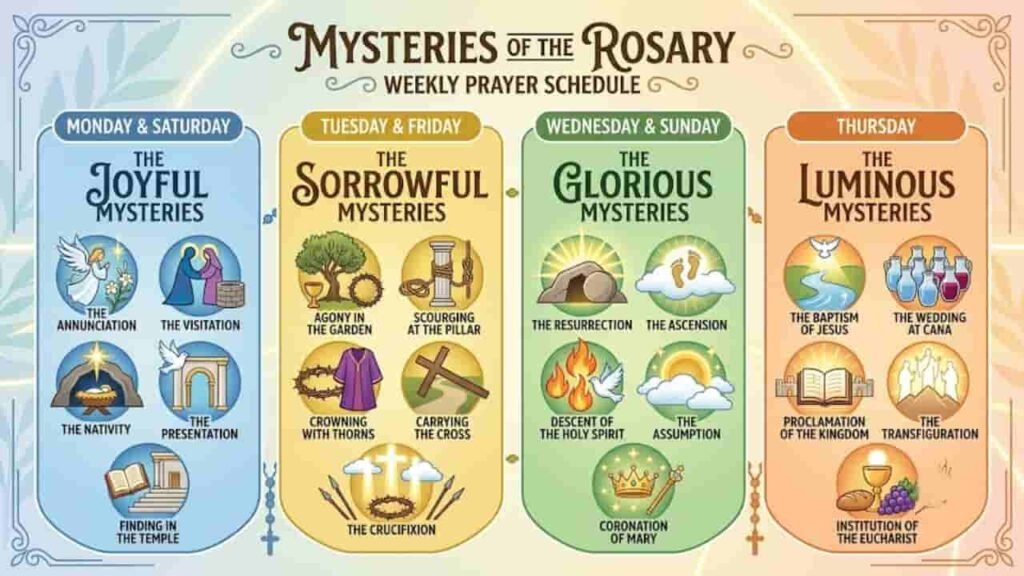
Catholic tradition commonly assigns different sets of Mysteries to different days of the week. Following a daily schedule can make it easier to remember which Mystery to meditate on without having to decide each time you pray.
The commonly used Rosary schedule is:
| Day | Mysteries |
| Monday | Joyful Mysteries |
| Tuesday | Sorrowful Mysteries |
| Wednesday | Glorious Mysteries |
| Thursday | Luminous Mysteries |
| Friday | Sorrowful Mysteries |
| Saturday | Joyful Mysteries |
| Sunday | Glorious Mysteries |
If you’re searching for the Rosary mysteries by day, this schedule provides a simple starting point. However, Catholics may choose another set for a particular reason, feast, liturgical season, or personal devotion. The schedule is a helpful tradition rather than a rule that prevents personal prayer.
The purpose of the schedule is to encourage regular meditation on the different parts of life. Over a week, the pattern gives you opportunities to reflect on His birth, ministry, Passion, Resurrection, and glory.
How Many Times Is Each Prayer Said in the Rosary?
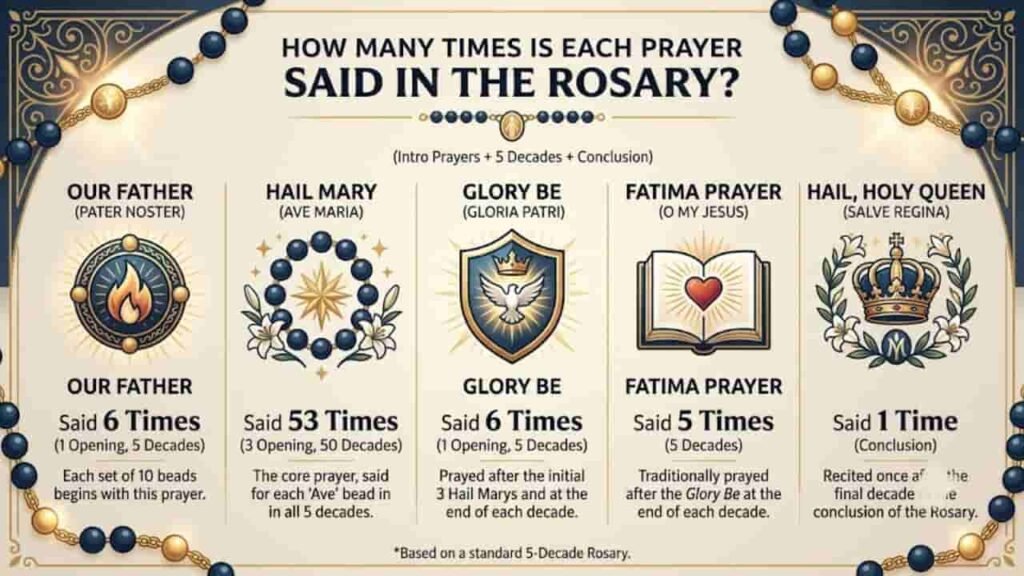
A standard five-decade Rosary contains a predictable sequence of repeated prayers. The exact count can vary slightly depending on whether you include only the prayers within the five decades or also count the opening and closing prayers. For a traditional five-decade Rosary, the main repeated prayers can be summarized as follows:
| Prayer | Common Number |
| Sign of the Cross | 2 times |
| Apostles’ Creed | 1 time |
| Our God | 6 times |
| Decade prayers | 53 times |
| Glory Be | 6 times |
| Devotional Prayer | 5 times |
| Traditional Closing Prayer | 1 time |
The total count comes from three prayers at the beginning and ten prayers in each of the five decades. This gives the standard five-decade Rosary a total of 53 prayers of this type.
The number of prayers shouldn’t become the main focus of the devotion. The structure exists to help you meditate. As you pray each decade, let the repeated words create a steady rhythm that gives your mind room to reflect on Christ and the Gospel.
The Meaning and Purpose of Praying the Rosary
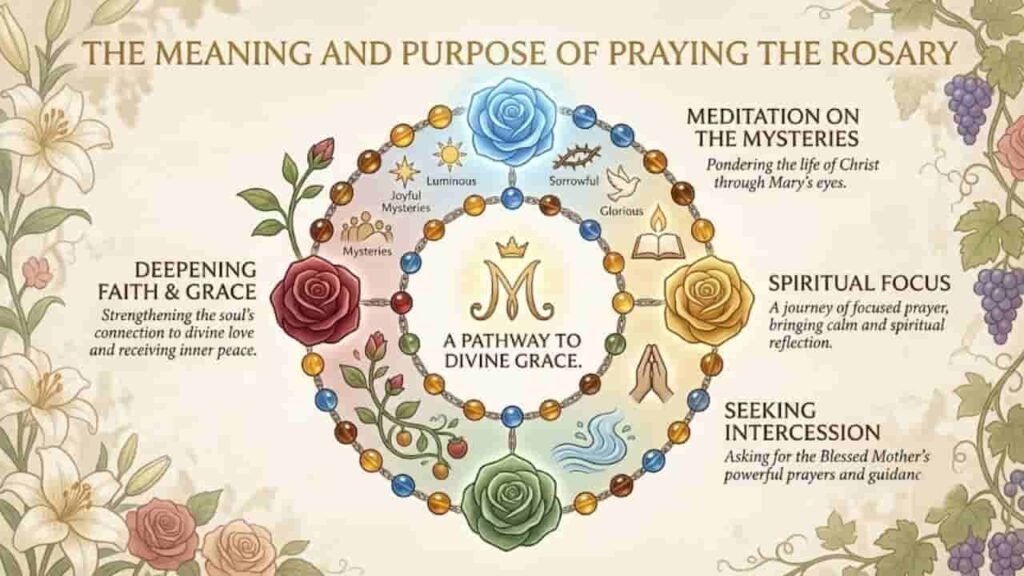
The meaning of the Rosary goes beyond holding a string of beads and repeating familiar prayers. At its heart, it is a form of Catholic devotion that combines vocal prayer with meditation. The Mysteries provide a framework for reflecting on The Savior while the decade prayers and other prayers create a steady rhythm.
Many Catholics pray the Rosary because it can provide a quiet structure for daily prayer and spiritual reflection. It can help you slow down, turn your attention away from distractions, and contemplate important moments in the Gospel. The Rosary is also closely associated with Marian devotion, but its mysteries remain centered on the life and saving work of The Savior.
The purpose of praying the Rosary can differ from one person to another. Someone may pray for peace during a difficult season, while another person may offer a decade for a family member, a personal need, thanksgiving, or a desire to grow in faith.
For some people, the Rosary becomes part of a daily prayer routine. Others pray it occasionally, especially during times of grief, uncertainty, gratitude, or spiritual need. There is no need to make your prayer complicated. A sincere few minutes of focused prayer can be a meaningful beginning.
Tips for Praying the Rosary With Focus and Devotion
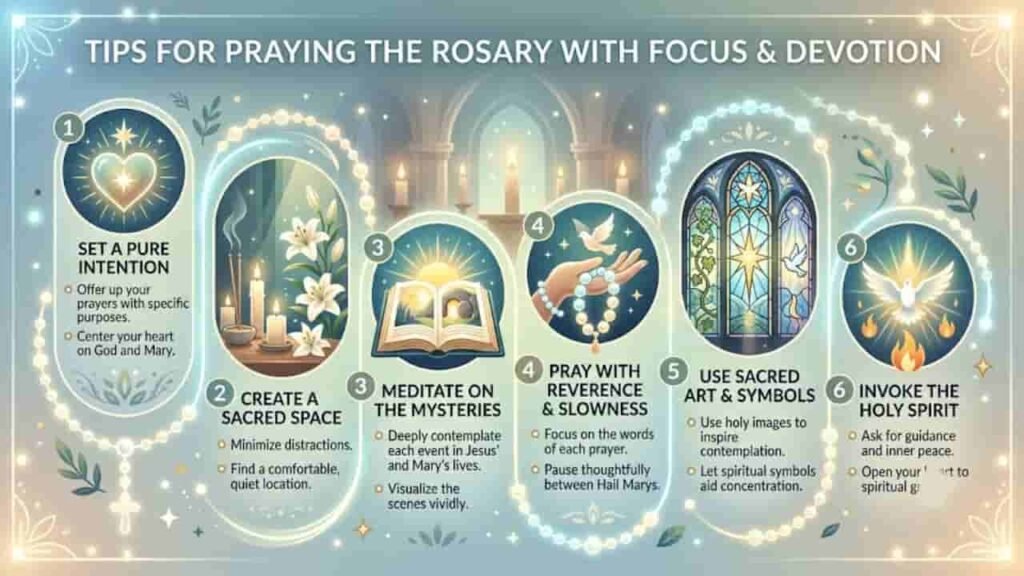
If you’re learning how to pray the Rosary for beginners, start slowly. Keep your Rosary beads in your hand and follow one bead at a time. You can also keep this guide or a prayer card nearby until the order becomes familiar.
Try to focus on the Mystery rather than worrying about whether you are praying quickly enough. Before each decade, briefly picture the Gospel event and consider what it reveals about The Savior, Mary, faith, suffering, obedience, or hope. This simple habit can turn the Rosary from a memorized sequence into a more reflective prayer experience.
Here are some practical ways to develop a more focused Rosary practice:
- Choose a quiet place where interruptions are less likely.
- Begin with the Sign of the Cross and take a moment to settle your thoughts.
- Announce the Mystery before beginning each decade.
- Think about the Gospel scene while praying the decade prayers.
- Avoid rushing simply to finish the Rosary.
- Use Scripture passages related to the Mystery for deeper meditation.
- If you lose count, don’t panic. Find your place and continue.
- If a full Rosary feels difficult, begin by praying one decade.
- Choose a regular time of day if you want to build a daily habit.
- Offer your Rosary for a specific intention when that helps you pray with purpose.
You don’t have to achieve perfect concentration. Distractions are a normal part of prayer. When you notice your mind wandering, gently return your attention to the words and the Mystery without becoming frustrated with yourself.
Common Questions About the Prayers of the Rosary
Learning the Rosary often raises practical questions, especially for someone who hasn’t prayed it before. The answers below address some of the most common concerns about the order, number of prayers, and basic Rosary practice.
FAQs
What Are the Main Prayers of the Rosary?
The main prayers include the Sign of the Cross, Apostles’ Creed, Glory Be, and other traditional devotional prayers.
How Many Marian Prayers Are Included in the Prayers of the Rosary?
A standard five-decade Rosary contains 53 Marian prayers: three during the opening prayers and 50 across the five decades.
What Are the Four Mysteries Included in the Prayers of the Rosary?
The four mysteries are the Joyful, Sorrowful, Glorious, and Luminous Mysteries. Each group contains five mysteries for meditation.
Which Mysteries Are Included in the Prayers of the Rosary for Each Day?
The common schedule assigns Joyful Mysteries to Monday and Saturday, Sorrowful to Tuesday and Friday, Glorious to Wednesday and Sunday, and Luminous to Thursday.
Can a Beginner Easily Learn the Prayers of the Rosary?
Yes. A beginner can learn the Rosary by following the bead sequence and using a written prayer guide until the prayers and order become familiar.
Conclusion
The Prayers of the Rosary bring together familiar Catholic prayers with meditation on important mysteries connected with The Savior and Mary. Understanding the prayer order, five decades, four mystery groups, and daily schedule can make this devotion much easier to approach.
Whether you are learning the Rosary for the first time or returning to it after many years, you do not need to pray perfectly. The Prayers of the Rosary can become a steady opportunity for reflection, faith, repentance, and hope as you turn your heart toward God.

PrayersGrace is a destination for heartfelt prayers, faith-filled messages, and inspirational words, managed by Olivia Bennett, an SEO content writer with 2 years of experience, focused on creating meaningful content that encourages, comforts, and uplifts readers.