
Ever finished the last Marian prayer of your rosary and paused, wondering, “Okay, what comes next?” You’re not alone. Many of us know how to pray for decades, but the rosary ending prayers can feel confusing, especially when every website or prayer book seems to say something slightly different. It’s frustrating to want to end your prayer time well and not be sure you’re doing it right.
In this post, we’ll walk you through the Rosary Ending Prayers step by step, from the traditional closing prayer to the final closing prayer and sign of the cross. You’ll learn what each prayer means, why it matters, and how to say them with confidence and peace. By the end, you’ll have a clear, simple guide you can come back to every time you pray.
What Are Rosary Ending Prayers?
Rosary ending prayers are the prayers you say after the final decade to close the Holy Rosary. Think of them as the last few minutes of a good conversation. You’ve walked through the mysteries of the Rosary, and now you wrap up with praise, thanks, and trust.
Most Catholics know them as the concluding prayers of the Rosary. They usually include the traditional closing prayer, a short versicle, and a closing prayer. Together, these closing prayers for the Rosary give your devotion a clear finish. Without them, your prayer can trail off right after the last Marian prayer.
Traditional Rosary Ending Prayers

The traditional way to close the Rosary follows a simple pattern. After the fifth decade, you pray the traditional closing prayer. Then comes a short versicle and response, followed by a closing prayer. These traditional Catholic prayers have guided Rosary devotion for generations.
Here’s the good news. The traditional prayers are short enough to learn in a week or two. You don’t need a fancy prayer book. Below, you’ll find the three most common options.
Read More: Prayers After the Rosary: What to Pray When You Finish the Rosary
God (Regina)
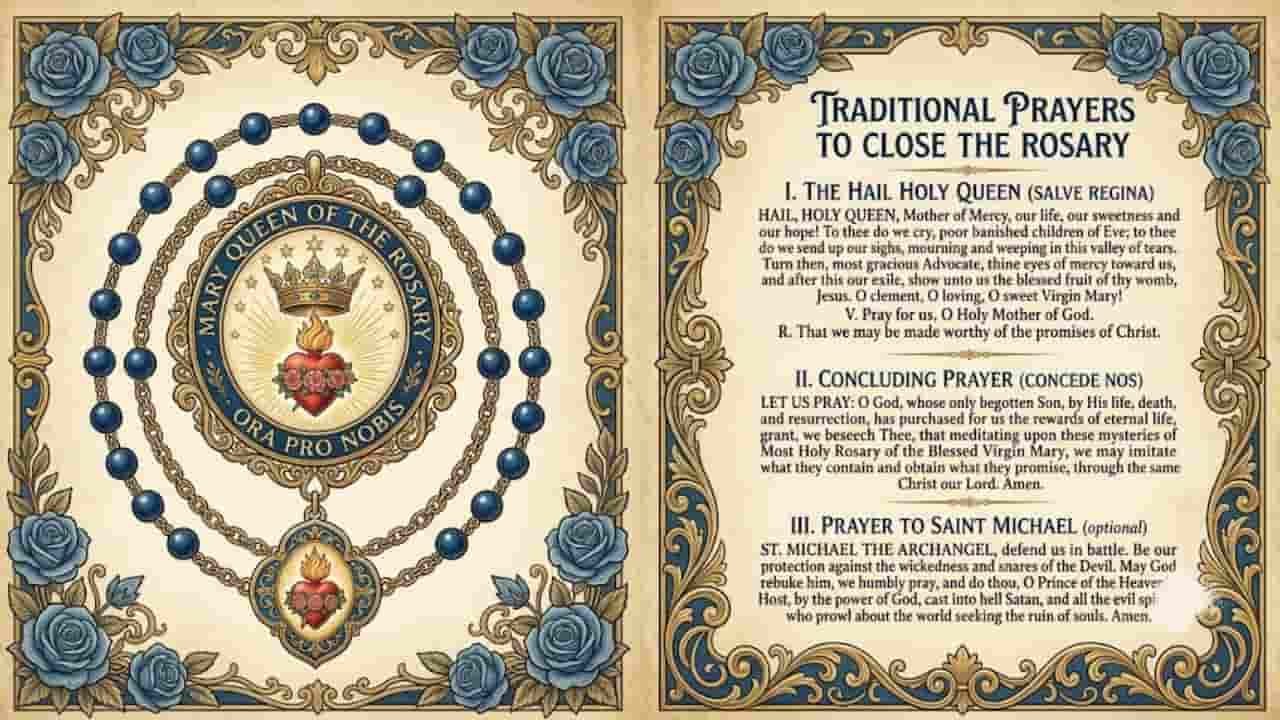
The traditional closing prayer, also called the Salve Regina, sits at the heart of the traditional ending. It honors Mary as Queen of Mercy and asks for her help through life’s hardships. Catholics have prayed it for centuries. Here’s the traditional text:
“Hail, Holy Queen, Mother of Mercy, our life, our sweetness, and our hope. To thee do we cry, poor banished children of Eve; to thee do we send up our sighs, mourning and weeping in this valley of tears. Turn then, most gracious advocate, thine eyes of mercy toward us; and after this our exile, show unto us the blessed fruit of thy womb, Jesus. O clement, O loving, O sweet Virgin Mary.”
Prayer After the Rosary
After the traditional closing prayer, many people say a short versicle and a closing prayer. The versicle asks Mary to pray for us. The closing prayer, known as a collect, asks God to help us live out what we’ve just meditated on.
V. Pray for us, O holy Mother of God.
R. That we may be made worthy of the promises of God.
“Let us pray. O God, whose only-begotten Son, by His life, death, and resurrection, has purchased for us the rewards of eternal life; grant, we beseech Thee, that meditating upon these mysteries of the most holy Rosary of the Blessed Virgin Mary, we may imitate what they contain and obtain what they promise. Through the same our God. Amen.”
Final Prayer to the Blessed Virgin Mary
Some families finish their rosary ending prayers with one more prayer to Mary. The Memorare is a popular choice. It’s short, confident, and full of trust.
“Remember, O most gracious Virgin Mary, that never was it known that anyone who fled to thy protection, implored thy help, or sought thy intercession was left unaided. Inspired by this confidence, I fly unto thee, O Virgin of virgins, my Mother; to thee do I come, before thee I stand, sinful and sorrowful. O Mother of the Word Incarnate, despise not my petitions, but in thy mercy hear and answer me. Amen.”
Read More: Prayers and Pilates: How to Combine Faith, Movement, and Wellness
How to End the Rosary Step by Step
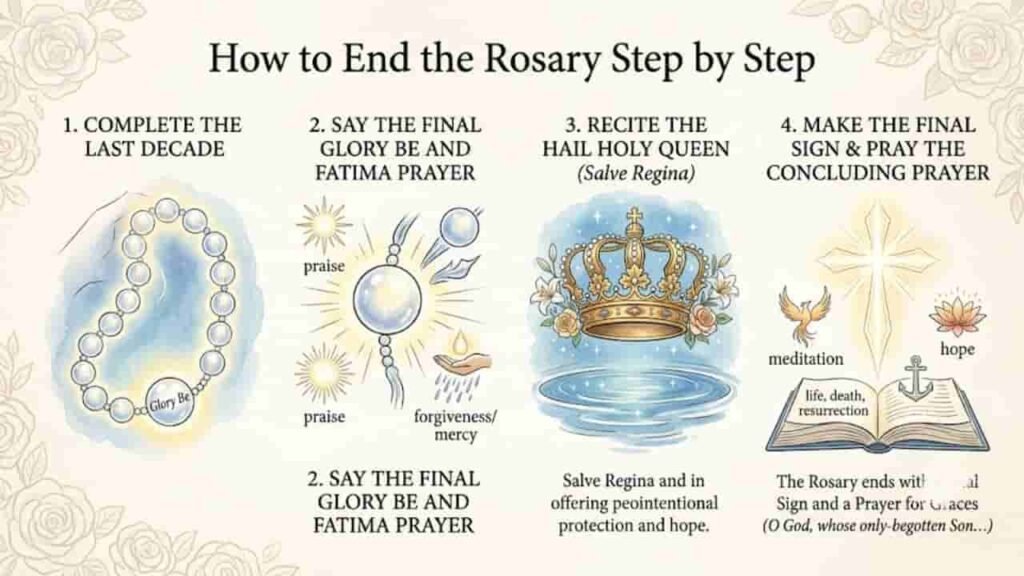
Learning how to end the Rosary is easier than it looks. Once you know the order, the prayers flow naturally from one to the next. The whole ending takes only a few minutes.
However, the sequence matters if you want to follow the traditional pattern. Keep your Rosary beads in your hands until the final Sign of the Cross. Here’s the order at a glance:
| Step | What you pray |
| 1 | Final decade: Our God, ten Marian prayers, Glory Be (and the additional prayer Prayer, if you use it) |
| 2 | traditional closing prayer |
| 3 | Versicle and response |
| 4 | Closing prayer |
| 5 | Sign of the Cross |
Complete the Final Decade
Finish all five decades of the Rosary first. On the last decade, pray the Our God, ten Marian prayers, and the Glory Be. Add the additional prayer Prayer if you usually say it. You’ve just finished the last mystery, so give it a quiet moment before you move on.
Pray the traditional closing prayer
Next, pray the God. Say it slowly. Many people rush it because the end feels near. Its words deserve better. They ask Mary, the Queen of Heaven, to turn her merciful eyes toward you.
Offer Your Closing Prayer
Finish with the versicle and the closing prayer. Then make the Sign of the Cross. If you carry specific intentions, this is a good moment to name them. You can also close the Rosary with a prayer in your own words.
What Prayer Do You Say After the Rosary?
The most common answer is the God. Among all the prayers, it’s the one nearly every Catholic recognizes. After it, you pray the versicle and the closing prayer. That answers the question of what prayer follows the God.
Some people add extra prayers. A few say prayers for the Pope’s intentions or a prayer to Saint Michael. These are optional, and what comes after the last decade of the Rosary can vary by parish or family custom. Still, the God and the closing prayer form the core.
Prayers to Say After Completing the Rosary

Once the traditional prayers are done, you may want to stay a little longer. This is a lovely time to give thanks and entrust your intentions to God. There’s no strict rule here. Short, sincere prayers work best.
Below are four simple prayers you can use or adapt. Each takes less than a minute. Feel free to change the wording until it sounds like you.
Prayer of Thanksgiving
Start with gratitude. A quick thank-you reminds you that prayer isn’t only about asking. It’s also about noticing what God has already given.
“God, thank you for this time of prayer. Thank you for Mary’s example and for the blessings of this day. Help me carry this peace into everything I do. Amen.”
Prayer for Peace and Protection
Peace and protection are two of the most common intentions people bring after the Rosary. Say this prayer when the day has been heavy or the world feels loud.
“Mary, Queen of Peace, pray for us. Keep our hearts calm and our homes safe. Protect us from harm and fear. Lead us closer to your Son. Amen.”
Prayer for Family and Loved Ones
Many people pray for family and loved ones before they put the beads away. Name each person if you can. It makes the prayer feel personal.
“God, bless my family and everyone I love. Comfort those who struggle. Bring us together in your peace. Amen.”
Prayer for Guidance and Strength
When you face a big decision, ask for direction. This prayer is short enough to memorize. It also works well as a quiet prayer in the middle of a busy day.
“God, guide my steps and strengthen my heart. Help me trust your plan, even when I can’t see the way. Through Mary’s intercession, give me courage. Amen.”
Rosary Ending Prayers for Different Intentions
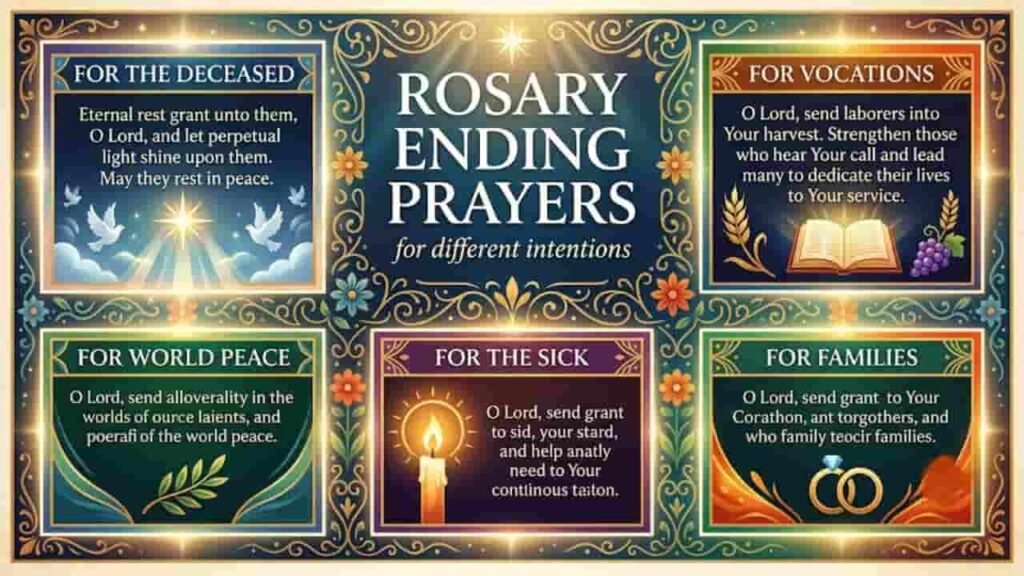
Every Rosary carries a purpose. Maybe you’re praying for a sick friend. Maybe you just need calm. prayers give you a natural place to hand that need to God through Mary’s intercession.
This section works differently from the last one. Instead of ready-made prayers, you’ll find ways to offer each intention with focus. That’s intercessory prayer at its simplest. You name the need, ask for Mary’s help, and place it in God’s hands.
For Healing and Comfort
Begin by naming the person or situation. Then ask for healing in body, mind, or spirit. Keep it simple, like “God, heal my friend and comfort her family.” If the illness is your own, say so honestly. God can handle your honesty.
For Family and Loved Ones
If you pray with your household, let each person voice one intention aloud. Then finish together with an Amen. A parent might mention a child’s exam. A spouse might ask for patience. Specific prayers tend to feel more real, and children often love this part.
For Peace and Protection
Peace and protection intentions often rise when life feels uncertain. Offer your worries for your home, your workplace, or the wider world. Then let go of them for a moment. That’s the point of trust. You hand the burden over.
For Guidance and Hope
When you feel stuck, ask for light instead of answers. Ask God to show you the next step. Also ask for hope, since hope is often what’s missing. Many people find that a few quiet seconds after this intention bring more clarity than an hour of worrying.
Prayers Traditionally Associated With the Rosary
The Rosary isn’t just one prayer. It’s a set of prayers that work together. Each one plays its part. The prayers simply complete the pattern.
Knowing these prayers helps you see how the whole devotion fits together. It also makes the ending feel less like an add-on. Here’s how each one fits into Catholic prayer tradition.
The Apostles’ Creed
The Creed opens the Rosary. It states the core beliefs of the Catholic Church in a few lines. You pray it while holding the crucifix. Starting with faith sets the tone for everything that follows.
Our God
Jesus taught this prayer to his disciples. In the Rosary, you pray it at the start of each decade. It reminds you that Mary’s prayer always leads back to the God.
Marian prayer
The Marian prayer forms the backbone of the Rosary. You pray it fifty times across the five decades, plus three more at the start. That repetition isn’t empty. It creates a steady rhythm that lets your mind rest on the mysteries.
Glory Be
The Glory Be ends every decade. It gives praise to the God, the Son, and the Holy Spirit. Many people add the additional prayer Prayer right after it. Keep in mind that the additional prayer Prayer belongs between decades, not at the very end.
God
Finally, the God closes the devotion. It’s a Marian prayer with medieval roots. Its language of exile and mercy fits the human journey well. Praying it after the last decade turns the whole Rosary into a plea for Mary’s care.
Can You Add Your Own Prayer at the End of the Rosary?
Yes, you can. Adding your own words to the rosary ending prayers is common. The traditional prayers give you a solid frame. After the God and the closing prayer, a few personal words can make the moment yours.
Keep it simple. Share your prayer intentions, thank God for something specific, or ask Mary to pray for someone. You don’t need polished language. God knows your heart. For example, “God, help me forgive my brother. Amen” is a perfectly good prayer.
Why End the Rosary With a Prayer?
Ending with a prayer gives the Rosary a sense of completion. Without it, the devotion can feel like it stops mid-thought. The closing prayers work like the final chord of a song. They settle everything into place. That’s why the rosary ending prayers matter so much.
They also help you give thanks after praying and honor the Blessed Virgin Mary. Over time, they deepen your devotion to Mary. Each Rosary builds on the last. The ending is where you gather the fruit of your prayer.
How to Make Your Rosary Ending More Meaningful
Meaning doesn’t come from speed. It comes from attention. Even short rosary ending prayers feel rich when you say them with care. Try slowing down, and ask yourself which mystery spoke to you most today.
Small habits make a big difference. Here are a few you can try:
- Light a candle or sit before an image of Mary.
- Name one intention aloud.
- Read the closing prayer slowly, phrase by phrase.
- Sit in silence for thirty seconds afterward.
- Write a one-line note in a prayer journal.
Choose one or two. You don’t need all of them.
Rosary Ending Prayers for Daily Prayer
Daily habits shape faith. If you pray the Rosary each day, a steady ending helps you settle into a rhythm. Using the same rosary ending prayers every time builds familiarity. Over time, the words start to feel like home.
Many families pray an evening Rosary ending prayer together. It closes the day and invites peace before bed. Others pray in the car or on a lunch break. Wherever you pray, continue in faith and prayer. A few calm minutes can carry you through even the busiest day.
FAQs
What prayer do you say at the end of the Rosary?
You say the traditional closing prayer, followed by a versicle and a closing prayer. These are the most common rosary ending prayers.
Is the traditional closing prayer said at the end of the Rosary?
Yes. Traditionally, it follows the fifth decade and closes the devotion.
Should you pray the additional prayer Prayer at the end of the Rosary?
The additional prayer Prayer is usually said after the Glory Be at the end of each decade. That means you’d pray it after the last decade and before the traditional closing prayer. It’s optional.
Can you pray for a specific intention after the Rosary?
Yes. After the closing prayer, name your intention aloud or silently and entrust it to God through Mary.
What comes after the five decades of the Rosary?
The traditional closing prayer comes first, then the versicle and response, the closing prayer, and the Sign of the Cross.
Conclusion
Ending the Rosary doesn’t have to feel uncertain. You now know the order: the last decade, the traditional closing prayer, the versicle, the closing prayer, and the Sign of the Cross. Once you learn these Rosary Ending Prayers, you’ll finish each Rosary with confidence.
Add your own intentions whenever your heart calls for it. Whether you pray alone or with family, the closing moments matter. Bookmark this guide and come back whenever you need a refresher. May your next Rosary end in peace.

PrayersGrace is a destination for heartfelt prayers, faith-filled messages, and inspirational words, managed by Olivia Bennett, an SEO content writer with 2 years of experience, focused on creating meaningful content that encourages, comforts, and uplifts readers.