
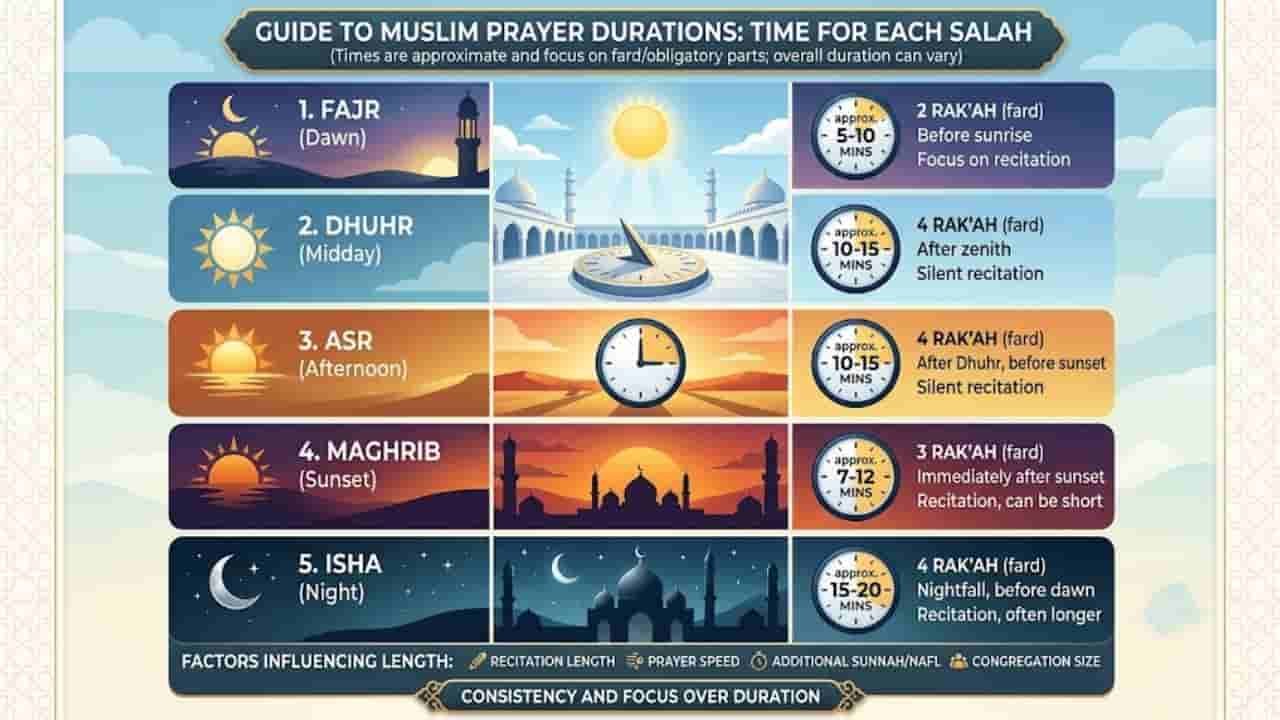
Have you ever stood at the edge of a prayer hall, or sat beside a Muslim friend or coworker, and quietly wondered how long Do Muslim prayers last? Maybe you didn’t want to ask in case it sounded rude, or maybe you’re new to Islam and worried about fitting prayer into a busy day. It’s a simple question, but finding a clear answer can feel surprisingly hard.
In this post, we’ll walk through how long Do Muslim prayers last, from a quick Fajr to the longer Friday congregational prayer. You’ll also learn what affects the timing, like praying alone versus in a group, so you’ll know what to expect and feel more confident planning around it.
How Long Do Muslim Prayers Last on Average?
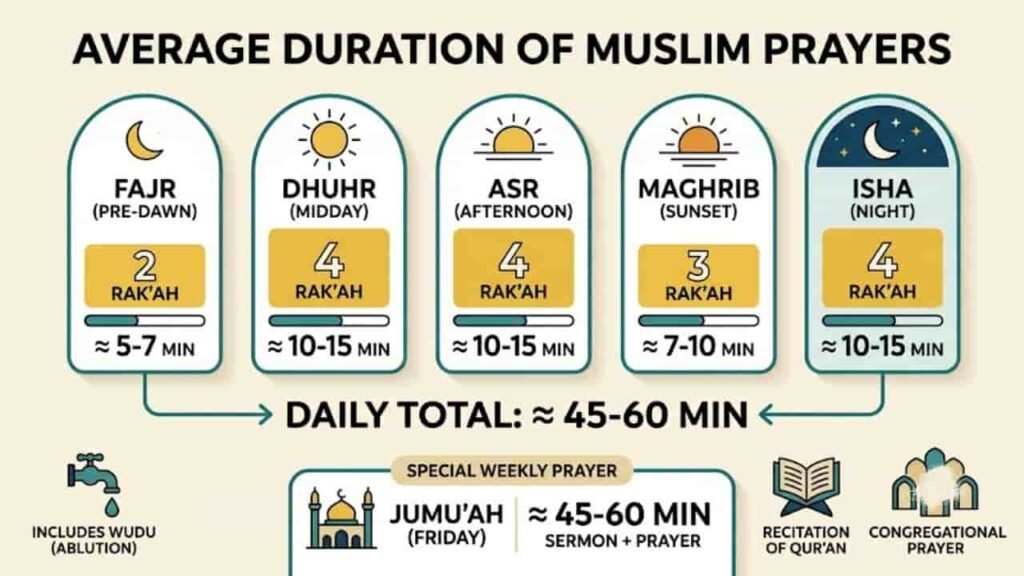
The short answer is that how long do Muslim prayers last depends on which Salah you’re praying. On average, one obligatory prayer takes about 3 to 8 minutes. That’s shorter than most coffee breaks, so completing prayer without unnecessary rushing is easier than many people think.
God, I thank You for the gift of prayer.
You gave me a quiet space in the middle of a loud world.
Help me value each moment I spend standing before You.
Let my heart stay present instead of drifting away.
Make this habit a source of peace, not pressure.
Keep me grateful for every chance to turn toward You.
Amen.
How Long Does Each of the Five Daily Muslim Prayers Take?
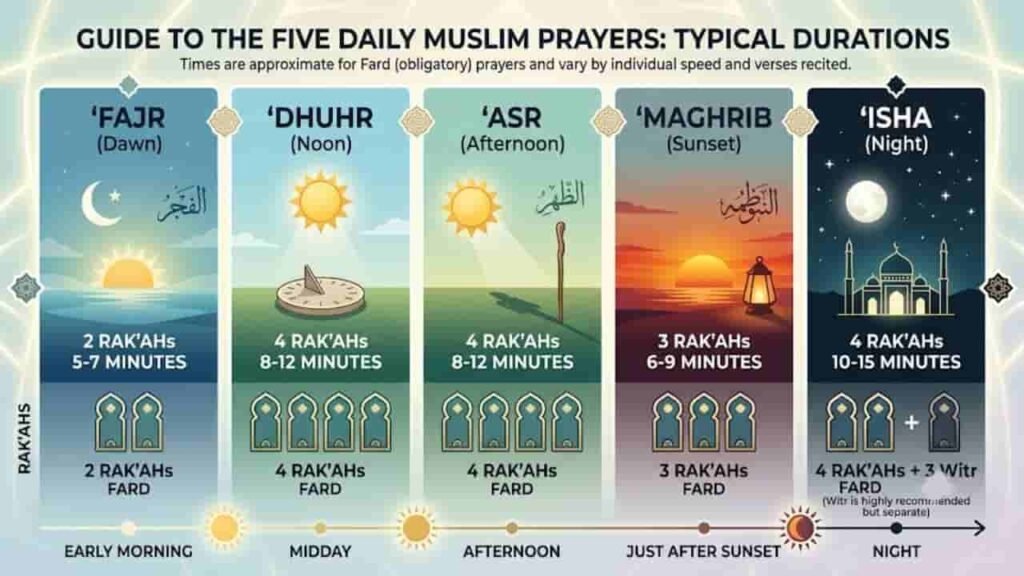
Islam asks Muslims to pray five times a day, and each prayer has its own length. The Adhan calls people to prayer, and the Iqamah announces that the congregation is about to begin. Each Salah has a set number of Fard Rakats, which is the main reason their lengths differ.
Guide me, God, through every hour of my day.
When work pulls me one way, call me back to You.
Give me steady discipline without making me harsh on myself.
Let each prayer mark a gentle pause in my routine.
Teach me to treat these moments as an anchor.
Keep my footing firm from sunrise until night.
Amen.
Read More: Saint Prayers: Powerful Prayers for Guidance, Healing & Protection
Fajr Prayer Duration
Fajr is the dawn prayer, and it has only two Rakats. Most people finish the Fard part in about 3 to 5 minutes. Because the recitation is often longer at dawn in a mosque, the Fajr prayer duration can stretch a little when an Imam leads.
Dhuhr Prayer Duration
Dhuhr happens at midday and includes four Rakats. Praying at a steady pace usually takes 5 to 8 minutes. If you add the Sunnah prayers around it, the Dhuhr prayer duration grows by a few more minutes.
Asr Prayer Duration
Asr is the afternoon prayer, and it also has four Rakats. It often runs 5 to 7 minutes, since the recitation tends to be shorter than at night. Many people squeeze it in between meetings, and that works fine.
Maghrib Prayer Duration
Maghrib comes right after sunset, and it has three Rakats. The Maghrib prayer duration is typically 3 to 5 minutes, which makes it one of the quickest. However, the time window is short, so people usually pray soon after the Adhan.
Isha Prayer Duration
Isha is the night prayer with four Rakats, and it takes about 5 to 8 minutes. Many Muslims follow it with the Witr prayer. That small addition adds a few minutes, but it wraps up the day nicely.
How Many Rakats Are in Each Daily Muslim Prayer?
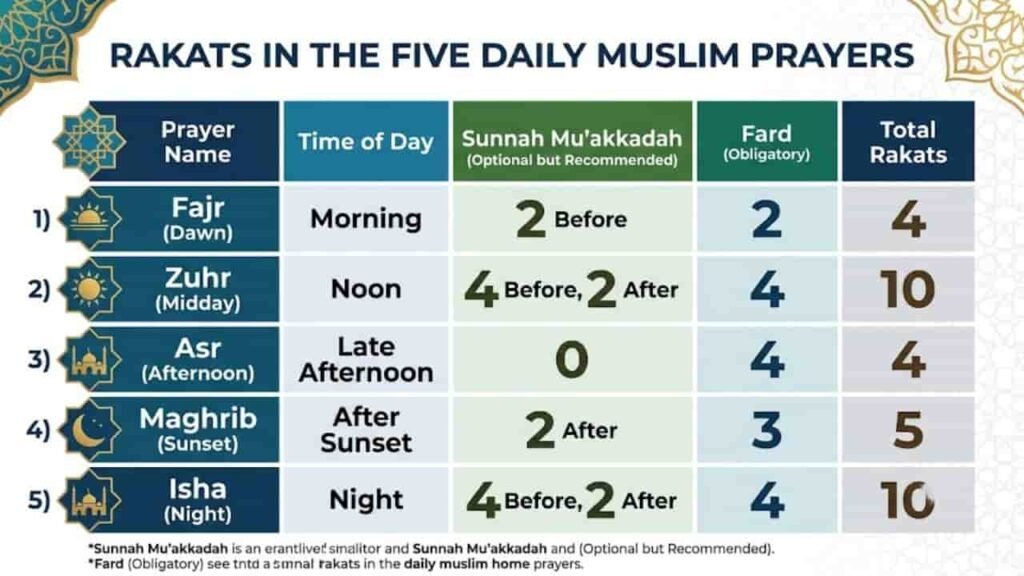
A Rakat is one full unit of Islamic prayer. It includes Qiyam (standing), Ruku (bowing), and Sujud (prostration), and the sitting recitation called Tashahhud comes after the final units. The number of Rakats in each prayer is fixed: Fajr has 2, Dhuhr 4, Asr 4, Maghrib 3, and Isha 4. That adds up to 17 obligatory Rakats a day.
Merciful God, clear my mind before I begin.
Quiet the noise that follows me onto the prayer mat.
Let my movements be calm and my words be deliberate.
Help me feel each bow and each prostration.
Turn my attention away from lists and worries.
Let my heart arrive before my body finishes.
Amen.
Read More: Powerful Deliverance Prayers for Protection, Freedom, and Strength
What Factors Affect How Long Salah Takes?
Not everyone prays at the same speed, and that’s perfectly normal. Variations in prayer duration among Muslims come down to a few clear factors. Understanding them helps you see how long Muslim prayers last in your own routine, and it takes the guesswork out of planning.
God, grant me patience when time feels tight.
Slow my racing thoughts and settle my breathing.
Remind me that worship is not a race.
Let me give my full attention, even on busy days.
Ease the worry that I’m taking too long or too short.
Fill my mind with calm as I stand before You.
Amen.
The Number of Rakats
More Rakats means more time. A two-Rakat prayer like Fajr naturally finishes faster than a four-Rakat prayer like Dhuhr. The same logic applies when you move from Fard prayers to extra voluntary ones.
Quran Recitation and Personal Prayer Pace
Quran recitation during Salah is a big factor. An Imam who recites longer passages will lead a longer prayer, while a quick reciter finishes sooner. When you pray alone, you set a comfortable pace and can slow down or speed up as you like.
Sunnah Prayers and Optional Prayers
Sunnah prayers follow the practice of the Prophet Muhammad, and Nafl prayers are purely voluntary. Neither is required, but many Muslims pray them regularly. For example, someone who adds Tahajjud in the late night will naturally spend more time in worship.
How Long Does It Take to Complete All Five Daily Prayers?
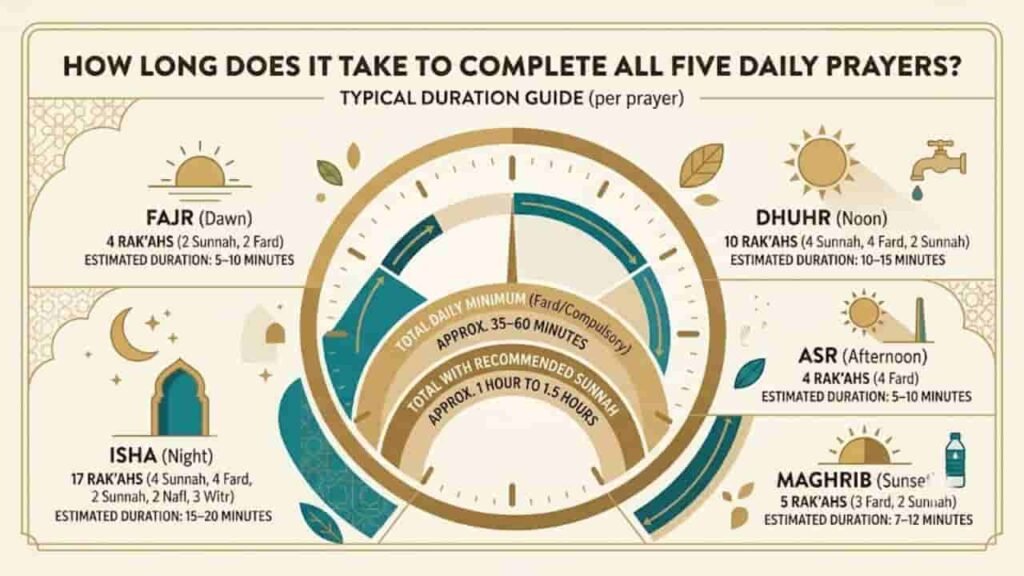
If you pray only the Fard prayers, the total is roughly 25 to 35 minutes a day. Add Sunnah prayers and Witr, and you’re looking at about 45 to 60 minutes. That’s how long Muslim prayers last across a whole day, and it fits easily into most Muslim prayer schedules.
| Prayer | Fard Rakats | Approx. Time (Fard Only) |
| Fajr | 2 | 3–5 min |
| Dhuhr | 4 | 5–8 min |
| Asr | 4 | 5–7 min |
| Maghrib | 3 | 3–5 min |
| Isha | 4 | 5–8 min |
| Total | 17 | 25–35 min |
God, bring balance to my busy life.
Don’t let work or worry crowd out my worship.
Help me see prayer as a gift of rest, not a chore.
Let my day bend gently around these moments.
Give me strength to stay consistent from morning to night.
Fill each hour with a sense of Your nearness.
Amen.
How Long Does Friday Jumu’ah Prayer Last?
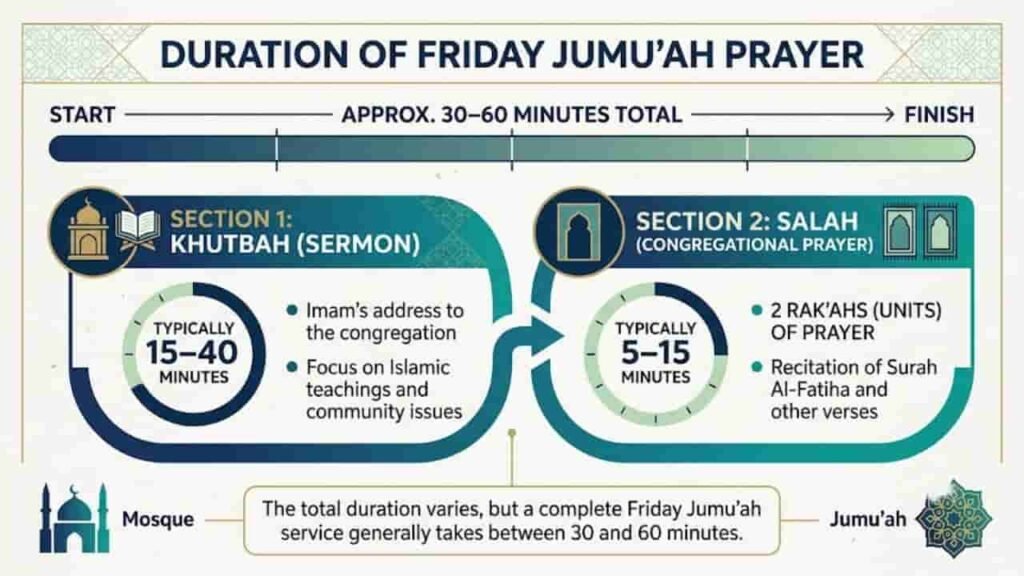
Jumu’ah is the Friday congregational prayer, and it replaces Dhuhr on that day. It has two Fard Rakats, but the sermon makes it longer. In fact, the sermon usually runs 15 to 30 minutes, so how long Muslim prayers last on Friday is closer to 30 to 45 minutes for the whole service. The duration of the Friday congregational service can vary by mosque.
God, bless the people who gather with me today.
Join our hearts, even when our lives look different.
Let the words we hear settle deep within us.
Soften any tension between neighbors and friends.
Make our community a place of kindness and welcome.
Carry the lessons of this day into the week ahead.
Amen.
How Long Does Muslim Prayer Take in a Mosque Compared With at Home?
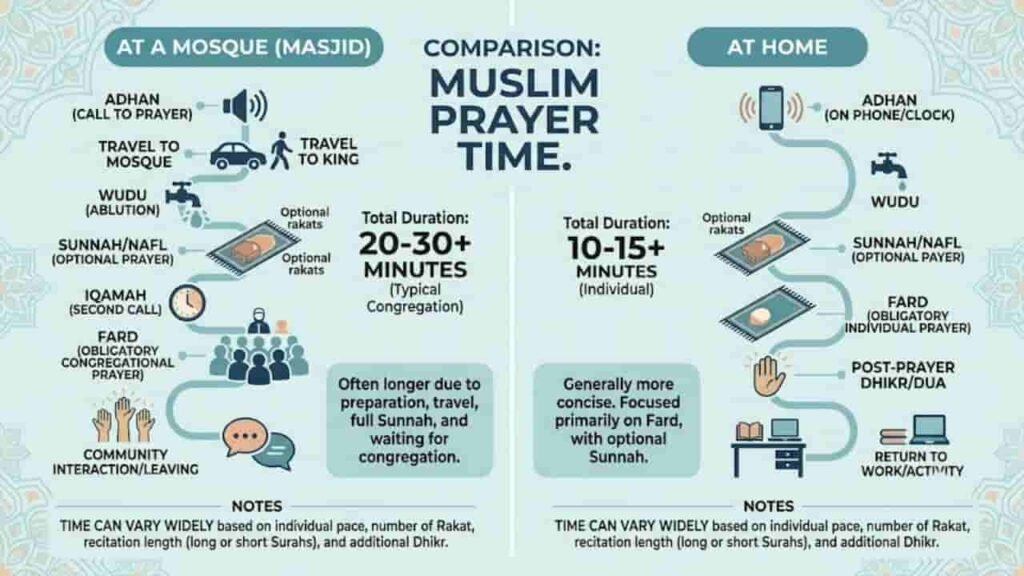
Praying in congregation is usually a bit longer than praying alone. Everyone follows the Imam’s pace, and people also need time to line up. At home on a prayer mat, you move at your own speed, so congregational prayer duration tends to run a few minutes more. Both are valid, and how long Muslim prayers last in each setting is still quite short.
God, let my sincerity be the same wherever I pray.
Whether in a crowded hall or a quiet corner, hear me.
Keep me from showing off and keep me from laziness.
Let my heart bow even before my body does.
Make my private worship as honest as my public one.
Accept what I offer, however small it seems.
Amen.
Do Muslim Prayers Take Longer During Ramadan?
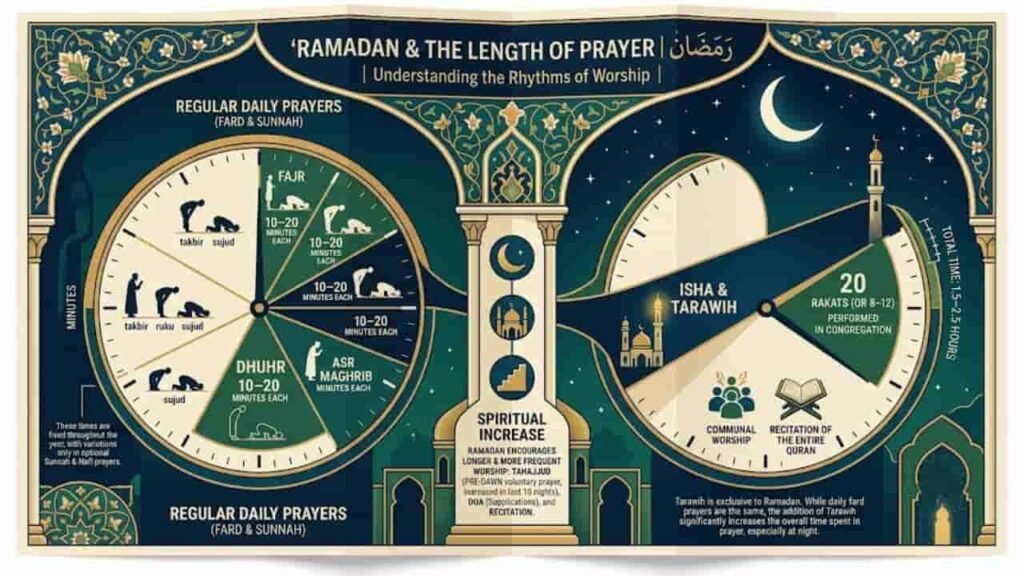
The five daily prayers stay the same in Ramadan. However, Taraweeh adds extra night prayers after Isha. It’s either 8 or 20 Rakats depending on the mosque, and it usually lasts 1 to 2 hours. In some places, the Quran is completed over the month, so the Taraweeh prayer duration can be even longer. That’s why people often wonder how long Muslim prayers last during this special month.
God, give me strength for the long nights ahead.
When my legs ache and my eyes grow heavy, hold me up.
Let the words I hear sink slowly into my heart.
Reward my effort, even when it feels clumsy.
Help me finish each night with joy, not exhaustion.
Fill this month with mercy, patience, and light.
Amen.
How Can You Estimate the Time Needed for Daily Salah?
Start by checking your local Islamic prayer timetable. Then allow a few minutes for wudu and preparation before each prayer. If you’re a beginner, plan on 10 minutes per prayer at first, because that gives you a stress-free buffer. As you practice, you’ll get a clearer sense of how long Muslim prayers last for you personally.
God, give me wisdom to plan my days well.
Help me make room for worship without feeling squeezed.
Show me where I waste time and where I can gain it.
Teach me to set aside moments that matter most.
Let my schedule serve my faith, not fight against it.
Bless every small effort I make to stay on track.
Amen.
FAQs
How long do Muslim prayers last?
Each obligatory prayer usually takes 3 to 8 minutes when prayed alone. All five together take about 25 to 35 minutes.
How long does it take to complete all five daily prayers combined?
Fard prayers alone take roughly 25 to 35 minutes a day. With Sunnah prayers and Witr, expect 45 to 60 minutes.
Does every Muslim prayer take the same amount of time?
No. The number of Rakats, recitation length, and personal pace all change the time. Fajr and Maghrib are usually the shortest.
How long does Friday Jumu’ah prayer last?
The full service, including the sermon, often takes 30 to 45 minutes. The prayer itself is only two Rakats.
How long is Taraweeh prayer?
Taraweeh usually takes 1 to 2 hours, depending on whether the mosque prays 8 or 20 Rakats. It can run longer when the Quran is being completed.
Conclusion
Now you know how long do Muslim prayers last, and the answer is probably shorter than you expected. Each obligatory Salah takes just a few minutes, and all five together fit into about half an hour. Add Sunnah prayers and Witr, and the total still stays under an hour. Friday Jumu’ah and Ramadan nights take longer because of the sermon and Taraweeh. However, those are special occasions, not everyday demands. Once you see the numbers laid out, prayer feels far less overwhelming than it first seems.
Of course, the exact time varies from person to person. The Rakats, the recitation, and your own pace all play a part, and praying in congregation usually adds a few minutes. So if you’re still asking how long do Muslim prayers last in your own routine, try a few days of steady practice and see what feels natural. Check your local prayer timetable and leave a small buffer for wudu. Most of all, remember that prayer isn’t about speed. It’s about showing up with a calm and present heart, so take the time you need and don’t rush.

PrayersGrace is a destination for heartfelt prayers, faith-filled messages, and inspirational words, managed by Olivia Bennett, an SEO content writer with 2 years of experience, focused on creating meaningful content that encourages, comforts, and uplifts readers.